
JEALOUS Zimbabweans ROAST Kim and Tanaka Over R8K Bed

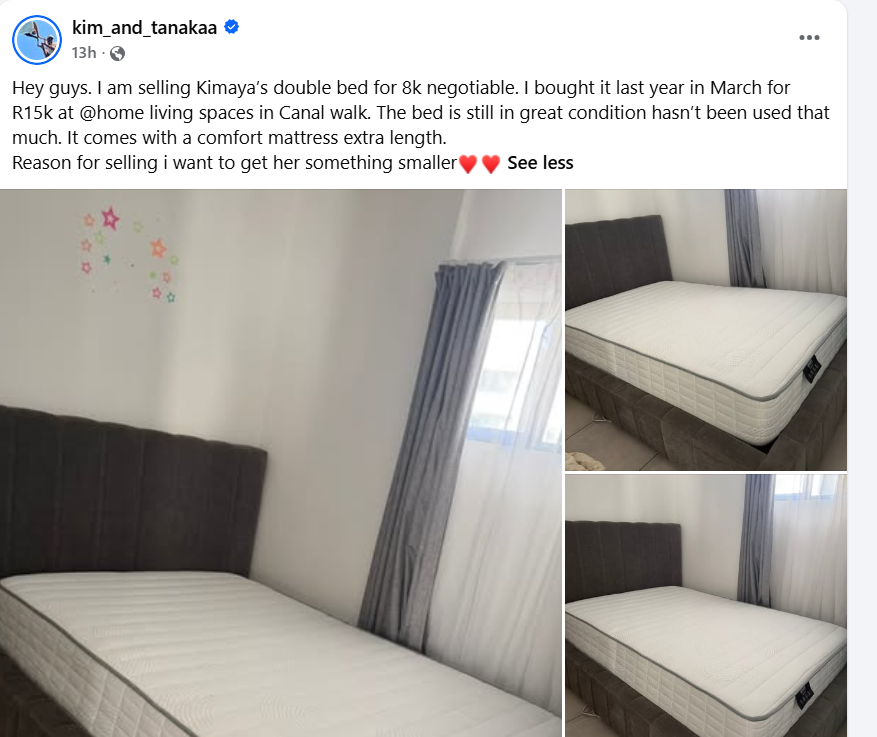
Kim and Tanaka's Facebook post advertising Kimaya's double bed for R8,000
Zimbabwean content creators Kim and Tanaka have been dragged into a fierce Facebook storm after advertising their daughter Kimaya’s second-hand double bed for R8,000.
What began as a straightforward marketplace post quickly became a national debate about money, social class, second-hand furniture and the uncomfortable jealousy that often follows successful Zimbabweans online.
The Cape Town-based couple has built a substantial audience by sharing family, relationship and lifestyle content, with a large following across YouTube and Facebook. However, their popularity did not protect them when Kim attempted to sell a bed that was no longer suitable for their daughter.
Kim and Tanaka Advertise Kimaya’s Bed for R8,000
In the verified Facebook post, Kim wrote that she was selling Kimaya’s double bed for 8k, negotiable, explaining that she had bought it the previous March for R15k at @home Living Spaces in Canal Walk. She said the bed was still in great condition and hadn’t been used much, and that the sale included a comfort mattress, extra length. Her stated reason for selling was that she wanted to get Kimaya something smaller.
There was nothing unusual about advertising unwanted furniture online. However, the R8,000 asking price immediately attracted attention, with commenters arguing that a second-hand bed shouldn’t retain more than half its original value — particularly with a used mattress included. Others questioned why the couple bought such a large, expensive bed for a young child only to decide a year later she needed something smaller.
“You’re Allowed to Just Scroll”
As criticism of the price intensified, Kim responded directly to a commenter, telling them that if they weren’t the target market, they were free to just scroll past the post.
That response changed the tone of the discussion. Instead of discouraging the critics, it gave them a new line to push back on — some argued that even the intended “target market” would be unlikely to pay R8,000 for a second-hand bed, while others accused Kim of sounding dismissive toward people simply questioning the price.
But was her response really arrogant? Kim wasn’t forcing anyone to buy the bed. She advertised her property at a price she considered reasonable and made clear the amount was negotiable. Anyone who felt the bed was too expensive was free to scroll past and buy elsewhere. That’s how an open market works.
Was the Anger Really About the Bed?
Some of the pushback on price was fair. But plenty of the comment section had little to do with furniture at all. Several commenters turned the conversation toward the couple’s spending habits, nationality and family choices — with more than one suggesting the bed should be sent “home” since the couple is building property in Zimbabwe, and others generalising about how Zimbabweans behave “when they see money.”
This is where legitimate criticism of a marketplace price started resembling something closer to personal resentment. A person can believe R8,000 is too expensive without turning it into commentary on the seller’s whole life, nationality or financial background.
The intensity of the response suggests the bed itself may only have been the spark. Kim and Tanaka’s public success, growing audience and visible lifestyle likely supplied the fuel. Successful Zimbabweans are often celebrated while they’re struggling — but as circumstances improve, admiration can just as quickly curdle into suspicion and resentment, with financial progress treated less like inspiration and more like something requiring an explanation.
Is R8,000 Too Much for a Second-Hand Bed?
The honest answer: R8,000 is an ambitious asking price, but not automatically an unreasonable one. At roughly 53% of the original R15,000 purchase price, for a bed reportedly around a year old, in excellent condition, from a recognised retailer, asking a little over half its original value isn’t inherently unjustifiable.
That said, the original receipt doesn’t set the resale value on its own. Buyers will weigh the current retail price of a comparable new bed, the item’s actual condition, transport and collection costs, and — likely the biggest weak point in this listing — general reluctance to buy a used mattress. That hesitation narrows the buyer pool and hands negotiating power to whoever does show interest.
So people are entitled to question the price. Questioning the price is not the same thing as attacking the family selling it.
The Market Will Deliver the Final Verdict
Kim and Tanaka can ask for R8,000, R10,000 or the full original R15,000 — it’s their bed to price. But they can’t force the market to agree. If it sells close to R8,000, the price was justified. If the ad sits unanswered for weeks, they’ll likely need to drop it.
That verdict won’t be decided by angry comments — it’ll be decided by whoever actually shows up with the money and a bakkie.
The Price of Living Publicly
Kim and Tanaka aren’t ordinary private sellers — they’re public figures who’ve invited an audience into significant parts of their family life. That visibility brings brand deals, ad revenue and reach. It also means a simple furniture listing can turn into public entertainment, with followers who’ve watched the couple’s journey feeling entitled to weigh in on their spending, parenting and property decisions. That’s the hidden cost of family content: audiences can start to feel that watching someone’s life gives them a say over it.
Our Verdict
R8,000 is a high asking price, and the couple should expect tough negotiation — especially with a used mattress in the deal. But a chunk of the backlash went well beyond price talk and into personal territory that had little to do with the bed itself.
Kim and Tanaka are entitled to test the market. Commenters are equally entitled to think the price is steep. Neither needs to make it personal.
The “target market” reply added fuel to an already heated thread, but the comments underneath also exposed a familiar pattern: celebrating people while they struggle, and turning on them the moment they look like they’re doing well.
The bed may or may not sell for R8,000. The jealousy on display underneath the post, though, was already free of charge.
What’s your verdict: is R8,000 reasonable for a lightly used bed originally bought for R15,000, or is the couple asking too much?
Related Stories